

Entry-level AI hiring faces real pressure. Entry-level job postings in the US dropped 35% in the last 18 months, largely due to AI automating routine tasks. At the same time, demand for AI skills in early-career roles nearly tripled since late 2025. More than one-third of entry-level jobs now require AI skills.
Tech forward means building capability fast. Employers prioritize demonstrated skills, AI tool fluency, and quick learning over traditional experience. PwC data shows AI-exposed junior roles now demand senior-level skills like leadership and strategic thinking 7 times more often than less-exposed roles.
This article outlines exact steps to navigate these changes. It covers high-growth roles, required skills, portfolio building, and job search tactics based on current 2026 labor data and employer trends.
The Current Landscape for Early AI Careers
Traditional entry points are shifting. Stanford research found a 16% relative decline in employment for early-career workers in AI-exposed roles. Software development and customer service positions saw the steepest drops.
Yet AI creates new openings. 50-55% of early-career workloads are now AI-augmented, letting juniors tackle complex tasks from day one. Companies report higher productivity when new hires collaborate effectively with tools like GitHub Copilot or similar systems.
The key problem is the compression of the career ladder. Routine work that once built foundational experience is now automated. This leaves a gap in hands-on learning. Successful early-career professionals bridge it with targeted projects and continuous upskilling.
Wikipedia offers a solid overview of foundational concepts in its Artificial Intelligence page. Start there before diving into tools.
High-Growth Roles Open to Early-Career Talent
Several roles stand out for 2026. AI-augmented software development leads with strong demand. Junior developers use AI to handle scaffolding and debugging, shifting focus to architecture and innovation.
Data analysis follows closely. Nearly 125,000 postings exist, with 16% growth. AI handles cleaning and preparation. Analysts deliver insights faster and tackle strategic questions earlier.
Cloud engineering remains accessible. Almost 45,000 postings show steady demand. 90% of entry-level workloads in this area run on cloud platforms. Cybersecurity in finance grew 62.5% in postings, as AI augments threat detection.
Data engineering powers AI systems. Over 103,000 postings and 12% growth make it vital. Junior engineers build pipelines that feed models.
Emerging options include prompt engineering, MLOps support, and responsible AI roles. These reward practical testing and ethical oversight more than advanced degrees.
Core Skills That Deliver Results
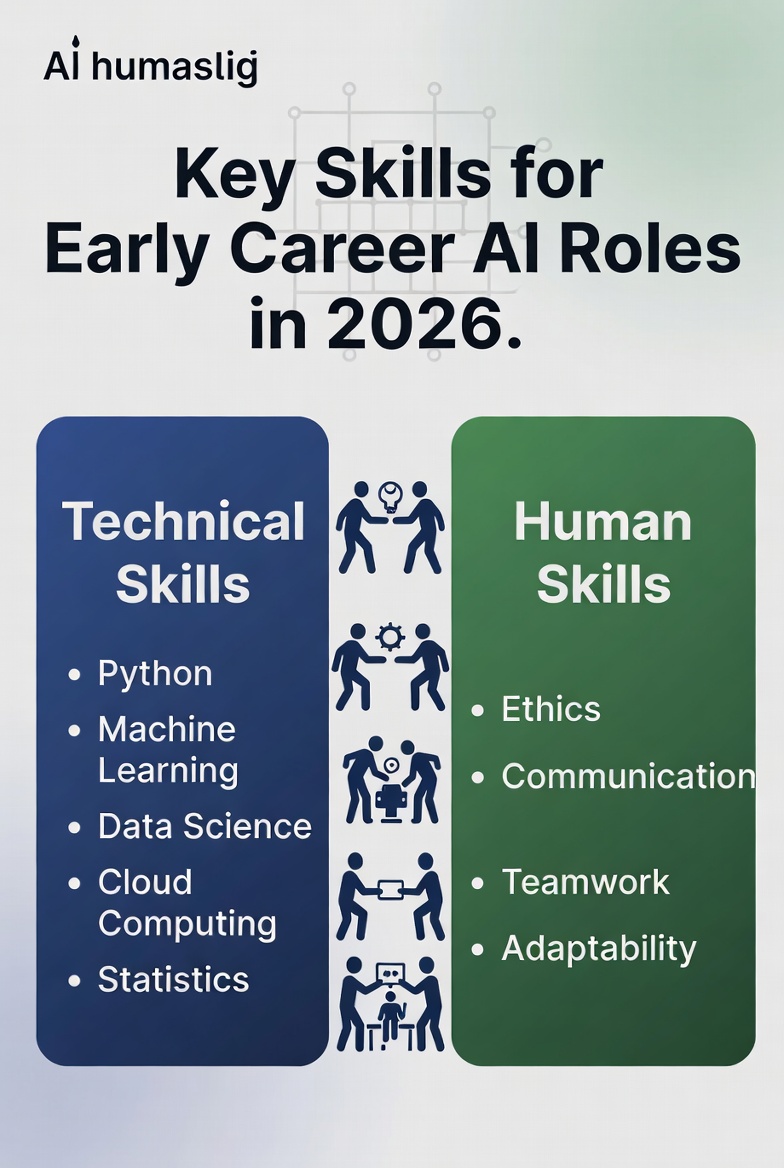
Focus on a focused mix of technical and human abilities. Python remains essential. Pair it with basics in PyTorch or TensorFlow for model work.
Master AI collaboration tools. Learn advanced prompting, version control with AI assistance, and debugging workflows. These cut task time significantly in real roles.
Cloud platforms matter. AWS, Azure, or Google Cloud certifications provide quick credibility. Many entry programs offer free access.
Power skills separate candidates. Employers seek systems thinking, clear communication of AI outputs, and ethical judgment. Bias detection and explainability are now routine expectations in responsible AI work.
Learning velocity counts most. Skills in specific frameworks lose relevance in about 2.5 years. Build habits for rapid adaptation through projects and experimentation.
Building Proof of Capability
Portfolios outperform resumes in skills-based hiring. Create 3-5 targeted projects. Build a personal AI chatbot with retrieval-augmented generation. Analyze public datasets for business insights. Contribute to open-source AI tools.
Document your process. Show how you used AI tools, where you applied human judgment, and measurable results. Host everything on GitHub with clear READMEs and live demos.
Participate in hackathons and short “sprinternships.” These 40-hour to 4-week programs connect directly to employers. Miami Tech Works and similar initiatives offer real examples of project-based entry.
Micro-credentials add structure. Stack AWS or Google AI certifications. They map directly to job requirements and show initiative.
Effective Job Search and Networking Tactics
Tailor applications around AI collaboration examples. Quantify impact: “Used AI tools to reduce data processing time by 60% in personal project.”
Target events like S&P Global’s Tech Forward networking sessions. Vector Institute mixers also connect talent with opportunities.
Prepare for interviews with live scenarios. Expect questions on prompting strategies, ethical dilemmas, and tool integration. Practice explaining complex outputs simply.
Consider alternative paths. Some new graduates build AI side projects or small tools that lead to full roles. Others join apprenticeships that emphasize applied work.
Long-Term Career Resilience
AI reshapes more jobs than it eliminates. Focus on areas where human oversight remains critical: context, accountability, and creative problem framing.
Maintain ethical literacy. Study frameworks from Google and IBM on responsible AI. These become competitive advantages as regulation increases.
Track your progress with regular self-assessments. Update skills quarterly based on job postings and industry reports.
Action Plan to Start Today
Review current job postings in your target roles. Identify skill gaps. Dedicate time each week to one project and one certification module.
Build a simple tracking system for applications and feedback. Adjust based on patterns.
The path rewards consistent, practical action over perfection. Early-career professionals who treat AI as a collaborator gain the clearest advantage in 2026.
This approach draws from ongoing labor market analysis and direct trends in tech hiring. Apply these steps methodically for stronger positioning in a changing field.



wow